
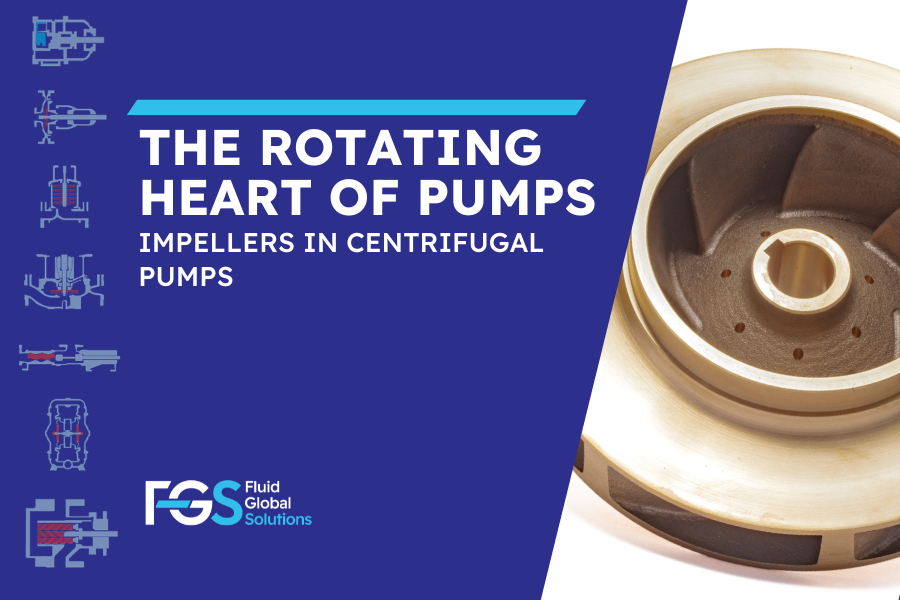
IMPELLERS IN CENTRIFUGAL PUMPS
That’s right: the impeller is the core component of the pump casing — the element that transfers energy to the fluid being pumped. It receives motion from the motor and converts it into kinetic energy, imparting it to the liquid. A disc featuring curved vanes that rotates inside the volute and, thanks to its design, generates a centrifugal motion that pushes the liquid outward. The geometry and dimensions of the vanes determine the pump’s efficiency and overall performance, influencing factors such as flow rate, head, and power consumption.
Yet, from the outside, centrifugal pumps all share a very similar structure, while what truly sets them apart is the type of impeller inside, which determines how they operate.
There are three types of impellers: closed, open, and semi-open. Their layout says more than mere aesthetics.
Closed impellers are ideal for applications requiring high hydraulic performance. The vanes are enclosed between two shroud discs (front and back), which create closed channels for the liquid to pass through, minimizing volumetric losses. Perfect for pumping clean, low-viscosity liquids, they are prone to clogging if the liquid contains solid particles larger than 2-3 mm. While production costs are higher, they generally require less maintenance over time.
Open impellers have no shroud discs; the vanes are “bare” and exposed to the passing liquid. This makes them suitable for handling liquids containing solids, such as wastewater, at low head. They offer lower hydraulic efficiency due to potential liquid recirculation, but their low cost and easier inspection and cleaning often make them the more economical choice in the long run.
There is also the semi-open impeller type (or semi-closed); it features a single shroud disc, making it suitable for handling fluids with a moderate presence of solids. It also occupies an intermediate position in terms of efficiency: higher than open impellers, lower than closed ones, since the liquid is not directly guided along the vanes as in the closed model.
Impellers are made from specific materials to ensure optimal performance depending on the application of the system they operate in. We find metal impellers, such as die-cast aluminum or cast iron, chosen for their mechanical strength and durability in demanding systems; polymer impellers, lighter and better suited to reducing stress on the system, are often used with corrosive fluids in industrial settings. In certain specific applications, metal impellers may also feature coatings in synthetic elastomers (such as EPDM or NBR) to increase resistance to wear or corrosion, each with its own field of use: EPDM offers good resistance to UV rays and seawater, while NBR is preferable for contact with oils and hydrocarbons.
When choosing the most suitable impeller, some criteria are decisive:
- Fluid type: the presence of solids or abrasive particles points toward open or semi-open impellers; for clean fluids, the closed impeller remains the most efficient solution.
- Required pressure and flow rate: high-head applications benefit from the greater hydraulic efficiency of closed impellers, while open impellers are better suited to low-head contexts.
- Application sector: in wastewater treatment or agriculture, where solids are common, open or semi-open impellers prevail; in the chemical and pharmaceutical industry, where maximum efficiency on clean fluids is required, closed impellers are preferred.
Choosing the right impeller — closed, open, or semi-open — requires a balance between fluid type, required performance, and application context.
EN:
At FGS, we support our clients in this choice by providing any type of impeller through our in-house production line.

More than centrifugal pumps