
When an acoustic nuisance signals a safety margin running out
Pumping systems account for roughly 20% of global electricity demand, with peaks that exceed 50% of total plant consumption in some industrial applications. A figure that makes clear why even a small inefficiency has a real impact on costs — and centrifugal pumps, being the most common type in industrial settings, represent a significant share of that consumption.
n our last deep dive, we covered impellers: shape, materials, selection criteria. But even a well-designed impeller can underperform — or suffer damage — if the pump’s suction conditions aren’t right. Cavitation is one of the most likely culprits, and anyone who works with pumping systems often recognizes it before they can even define it.
In this article, we’ll look at what cavitation is, what the term NPSH (which governs it) means and, above all, how to recognize and prevent it before it turns into a costly problem.
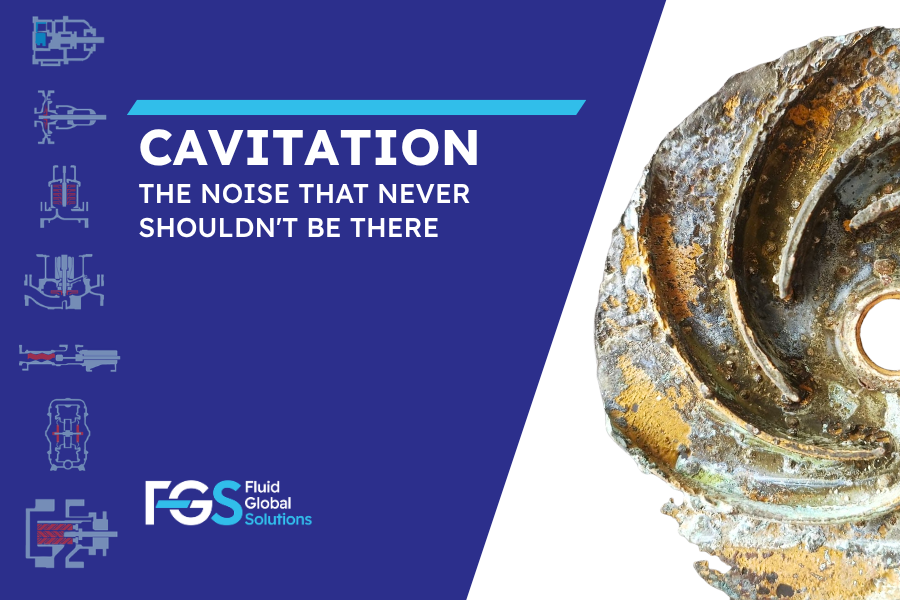
Picture liquid flowing through a suction pipe toward a pump. If pressure drops too far along the way, a “boiling” effect occurs (even at room temperature): small vapor bubbles form, and the moment they reach higher-pressure zones inside the pump, they collapse suddenly. This collapse is cavitation — a phenomenon that generates micro-impacts capable, over time, of eroding the impeller and other internal pump components.
The margin that determines whether this happens has a name: NPSH (Net Positive Suction Head). On one side, the available NPSH — the pressure the system can actually guarantee at the inlet. On the other, the required NPSH — the minimum the pump demands to avoid cavitating. The rule is simple to state, less simple to always respect: available must exceed required, with a safety margin. Even a small reduction in that margin translates into a real loss of efficiency, with a direct impact on energy consumption.
The signs that precede the onset of the phenomenon are clear and unmistakable. The most typical is acoustic: a noise similar to pebbles moving through the pipe, often accompanied by abnormal vibration. Add to this apparently unexplained drops in flow or pressure, and higher consumption under the same operating conditions.
The most common causes, from a system design standpoint:
- undersized or excessively long suction piping;
- suction lift greater than the original design allowed for;
- fluid hotter than expected (temperature directly affects available NPSH);
- partially closed valves or obstructions that reduce inlet pressure.
If the problem isn’t identified and corrected, it can turn a “bothersome noise” into an unplanned shutdown, with costs far higher than those of a preventive check.
Practical selection criteria
Prevention plays out at two moments: when the pump is first selected, and through ongoing monitoring of the system over time. At the selection stage, a few questions make the difference: what NPSH does the pump require under the expected operating conditions? Has a performance curve been provided for partial and peak loads too, not just the nominal point?
Even a well-designed system can develop problems over time: piping modifications, fluid changes, or increased flow rates can alter the available NPSH without anyone noticing — until the first symptoms appear. This is where external technical support makes a difference. FGS approaches the problem through a three-phase process:
- Diagnosis — assessing the system’s actual conditions and identifying the causes of cavitation (or its potential risk);
- Selection — if a new pump is needed, choosing the most suitable solution with the correct NPSH margin;
- Revamping — if the issue concerns an existing system, a targeted intervention without necessarily replacing the entire system.
If you recognize any of these signs in your own system, get in touch: our team can assess the situation and propose the most suitable solution.

More than centrifugal pumps