
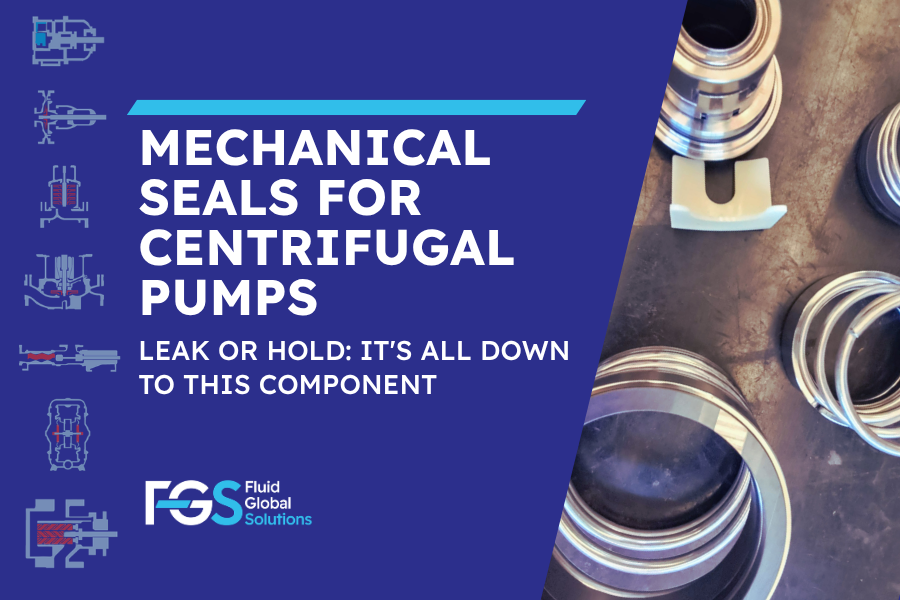
Leak or hold: it’s all down to this component
Necessary and decisive: the seal is the element that connects the shaft to the fixed body of a hydraulic machine, precisely at the point where the pumped liquid could escape. It is the seal that determines whether the pumped liquid remains in the system. An apparently small component that, in reality, affects the maintenance, energy consumption, and efficiency of the entire system.
Seals fall into two main categories: mechanical and packing seals.
The “veteran” packing seals work by wrapping braided cord (packing) around the shaft, compressed just enough to limit leakage without blocking rotation. A simple system, but with clear limitations: the packing wears down under pressure and friction, requires frequent maintenance, and needs a cooling liquid to prevent overheating caused by friction — which in turn increases the motor’s energy consumption.
Mechanical seals were developed to overcome these limitations. The principle is the same — sealing the space between the rotating shaft and the fixed housing — but the operation is different: two flat surfaces, one stationary and one rotating, slide against each other, held in contact by a spring and by the pressure of the pumped fluid. As a result, the seal lasts longer, needs less frequent maintenance, and reduces energy losses.
How a mechanical seal is built
A mechanical seal is made up of:
- a stationary part, fixed to the pump casing;
- a rotating part, fixed to the shaft and rotating together with it;
namely two faces (one fixed, one rotating) that slide in contact with each other, held under pressure by a spring and by the hydraulic force of the fluid.
It is precisely the continuous contact between these two faces, separated by an extremely thin fluid film, that ensures the seal. This same principle, however, also explains why no mechanical seal is ever 100% perfectly hermetic: that thin gap between the faces always leaves a small margin for leakage. The difference from packing seals is that, under normal conditions, the leakage is so minimal that it is not visible to the naked eye.
Main types
There is no single mechanical seal suited to all applications. Instead, the choice depends on the type of fluid being pumped and the operating conditions of the system:
- Bellows seals – recommended when the fluid contains suspended solid particles, which tend to interfere with the seal’s operation.
- Single seals – the most common configuration: a single sealing point, in which the pumped fluid itself lubricates the contacting faces.
- Cartridge or split seals – factory pre-assembled, they reduce the risk of installation errors and simplify replacement operations.
A Detail Not to Be Underestimated
The seal faces slide against each other at high speeds, up to 2900–3000 RPM. For this reason, proper lubrication and cooling are not minor details but necessary conditions for correct operation. If the pump runs “dry,” even for short periods, the surfaces overheat rapidly, leading to seizing and failure of the seal itself — resulting in fluid leaks that are, this time, clearly visible.
Why does it matter?
The choice of mechanical seal has a direct impact on the frequency of maintenance interventions, on system downtime, and on operating costs over time. As with pump materials, here too the right decision is one built on the actual operating conditions — type of fluid, pressure, continuity of operation — rather than on a generic standard.

More than centrifugal pumps