When and why each configurations is used in practice
Spot the differences
Spot the differences
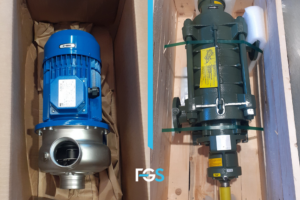
Spot the differences between these two centrifugal pumps
They’re not the same, are they?
It doesn’t take an expert eye to see that the difference is the pump’s configuration.
The most evident difference is the number of impellers used, which – in technical terms – is referred to as “the number of stages”.
A single-stage pump (image on the left) is equipped with one impeller that rotates on a shaft inside the pump casing.
A multi-stage pump (image on the right) contains multiple impellers (or stages) arranged in series with a single casing. Each impeller adds energy to the fluid, allowing the pump to achieve higher pressures than a single-stage pump.
So, when and why is each configuration used?
Let’s clarify. The number of impellers directly affects the head, making one configuration more or less suitable for a given application.
Single-stage pumps are typically used in applications where moderate head (i.e. not particularly high pressure) is required, along with relatively high flow rates, such as water supply systems, industrial processes for boosting and liquid transfer, ventilation, air conditioning, heating and agricultural irrigation.
Multistage pumps, on the other hand, are used when higher pressures are required, while maintaining a constant or variable flow rate, such as in water treatment systems, industrial processes, and heating and cooling applications.
In real-world applications, the choice between single-stage and multi-stage centrifugal pumps is rarely about the pump itself. It is rather about understanding the system in which it operates.
The flow rate, pressure, layout constraints, and operating conditions all play a role in defining the most suitable configuration.
While single-stage pumps offer simplicity, reliability and ease of maintenance, multistage solutions become essential when higher pressures are required.
EThere are also significant differences between models, both single-stage and multistage, related to performance, construction materials and the specific configurations adopted by manufactures.
In the next blog post, we’ll be focused on another key factor in centrifugal pump performance: material selection and its impact on durability, maintenance and long-term reliability.