
Common Uses and Operational Context
In our previous article, we introduced the main pump families used in marine and industrial environments, distinguishing between dynamic and positive displacement pumps. In this blog post, we take a closer look at centrifugal pumps, the most widely used type within the dynamic pump category, examining their most common applications and the operational contexts in which they are employed.
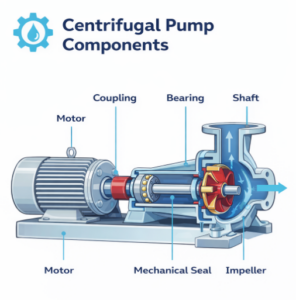
Centrifugal pumps schema by FGS
True to their name, centrifugal pumps convert the mechanical energy of the drive shaft into kinetic energy through the rotation of an impeller. This kinetic energy is then converted to pressure energy within the pump casing, enabling the liquid to exit the discharge nozzle in a continuous, steady flow.
Unlike positive displacement pumps, centrifugal pumps provide a flow rate that varies with head, while maintaining a stable, high-velocity, continuous flow.
They are particularly suited for handling low-viscosity fluids and can be configured to process mildly corrosive fluids or those containing limited amounts of solids. Thanks to this versatility, they are widely used in the marine sector, where they are employed in:
Cooling Systems – Seawater pumps handle large volumes of fluid for cooling main engines and generators.
Bilge Water Systems – They allow the removal of drainage water that collects in the lowest part of the vessel.
Ballast Water Systems – They manage the transfer of ballast water, which is essential for vessel stability.
Firefighting and General Service Systems – They provide high water flow rates to firefighting systems and other onboard services.
Fluid Transfer Systems – They are used for transferring fuel, lubricating oil and other fluids between different compartments of the vessel.
Offshore Applications – They are also used for seawater injection into reservoirs to support enhanced oil recovery operations.
In industrial settings, centrifugal pumps are used in:
Fluid transfer systems in the chemical, petrochemical, food and pharmaceutical industries
Wastewater treatment systems, sludge handling and desalination plants
Industrial processes, including boiler feed systems, cooling plants and process fluid circulation
As highlighted in our previous article, it is the characteristics of the system and the application that determine the most suitable pump configuration. Required flow rate, head, type of fluid and operating conditions all directly influence model selection.
Understanding the application context is therefore the first step toward correctly defining pump selection and, subsequently, its operational management.
In the upcoming article, we’ll dive into one of the main aspects of centrifugal pump setup, focusing on the differences between single-stage and multi-stage solutions.